Sermon: Prophet Will Rise Up

metoo
Pedro Fequiere for BuzzFeed

By Michael Boucher
Spiritus Christi, January 28, 2018

The year was 1968.  Almost five hundred women from the feminist and civil rights movements had gathered outside of Boardwalk Hall in Atlantic City, New Jersey to protest the Miss America pageant.  The organizers of the protest were opposed to the objectification and mistreatment of women and saw the Miss America pageant as an embodiment of so much that was wrong in our culture.  But they also saw the pageant being linked to other major social ills like racism (no woman of color had been allowed to participate), war (the Miss America winner would go ‘visit the troops’ in Vietnam) and materialism (because of all of the products that women were encouraged to buy to be ‘beautiful’).  So they literally crowned a live sheep Miss America to represent how women were being treated like livestock, threw objects of female oppression – like girdles, curlers and tweezers – into trash cans (no bras were burned, for the record, but women got blamed for it anyway!), they sang songs, and even secretly made their way into the actual Miss America pageant and unfurled a banner from the balcony that read “Freedom for Women”.   Their actions caused quite a stir to say the least. Continue reading “Sermon: Prophet Will Rise Up”

From A Birmingham Jail to the Modern Black Athlete

MLKFrom The Undefeated and ESPN collaborating on a tremendous series called  The State of the Black Athlete:
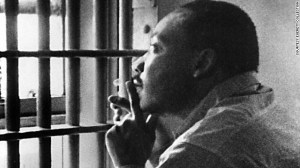
Martin Luther King Jr. penned his Letter from Birmingham Jail in a narrow cell on newspaper margins, scraps of paper and smuggled-in legal pads. He had no notes or reference materials. Yet, King’s eloquent defense of nonviolent protest and searing critique of moderation continues to resonate in a nation still divided by race. Continue reading “From A Birmingham Jail to the Modern Black Athlete”

Just Trying to Survive

WinonaFrom Winona LaDuke, the executive director of Honor the Earth, responding to an interview question from Amy Goodman about PTSD in the Native American community:

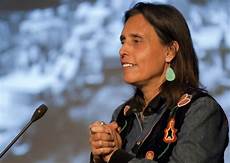
You say “Enbridge,” and I get this little like quirk because the Indian wars are far from over out here. But what you get is intergenerational trauma, is what it is known as, historic trauma. And other people have it. But you have a genetic memory, and every day you wake up, and you see that your land was flooded. And that big power line that runs through this land, that doesn’t benefit you. Everything that is out here was done at your expense, but you still have to pay for it. And every day you go out there, and you got a roadblock, that the white people put up, coming into your reservation. And every day you go out there, and you look at your houses, and you see that you’ve got crumbling infrastructure, and nobody cares about it. And you’ve got a meth epidemic, and you’ve got the highest suicide rates in the country, but nobody pays attention. So you just try to survive. That’s what you’re trying to do. Like 90 percent of my community, generally, I would say, is just trying to survive. Continue reading “Just Trying to Survive”

Learning from Laughter and the Trees: Dear Trump #2. The perfect gift.

27545226_1517543381692953_9067731188216851540_nBy Lydia Wylie-Kellermann

There has been a small, weekly vigil happening across from Isaac’s school for a year now. It started when a young girl told a social worker at school she was afraid of her friends and family being deported. When the social worker asked her if there was anyway that we could support her family, the little girl said she would feel better if ICE could see that people cared. So, this small vigil is one attempt at that- to publicly say to ICE that we stand with our neighbors and that we are paying attention. There is a commitment to keep standing in solidarity until there is a justice immigration policy in place and children can live without fear. Continue reading “Learning from Laughter and the Trees: Dear Trump #2. The perfect gift.”

Wild Lectionary: Transfiguration

27847750_10154970804366567_1328436879_n
Fresh buds on Tiger Mountain

Transfiguration B
Mark 9:2-9

By Sue Ferguson Johnson and Wes Howard-Brook

“Six days later, Jesus took with him Peter and James and John, and led them up a high mountain apart, by themselves.” (Mk 9.2)

It has been a long, wet, grey, dark winter so far here in the Issaquah Creek watershed. While we have been spared the intense cold and massive snowfalls visited upon our sisters and brothers to the east, the relentless “parade of storms” from the Pacific Ocean (as local weatherfolk like to call it) can wear away at even the most committed pluviophile. Continue reading “Wild Lectionary: Transfiguration”

Drowning in Whiteness

SeattleA [re]post from Ijeoma Oluo’s speech at “Interrupting Whiteness,” an event held on June 1, 2017 at the Central Library in Seattle, co-hosted by KUOW Public Radio.

Hi, I am Ijeoma Oluo, and I am a mixed race black woman who was raised by a white mother in this very white city.

I have a Ph.D. in whiteness, and I was raised in “Seattle nice.” I was steeped in the good intentions of this city and I hate it. I love this city. I love you guys. Also, I hate it. I really do.

And I’m going to talk a little bit about why. I write about race, and I’m regularly reached out to by really well-meaning white people who want to explain to me what my work is like to them as a white person and the white perspective that I’m missing.

And the only part of the white perspective I’m missing is the ability to be unaware of the white perspective. Continue reading “Drowning in Whiteness”

Abrihet Queen

picBy Lindsay Airey

This piece was developed during the second Bartimaeus Institute Online (BIO) Study Cohort 2016-2017.  These pieces will eventually be published in a Women’s Breviary collection.  For more information regarding the BIO Study Cohort go here.

Abrihet Queen, given name Valerie, was born on April 11, 1960, into the Core City neighborhood of Detroit, the sixth of nine children. Her parents worked hard and tirelessly to make ends meet. She soaked in beloved community, surrounded by a wealth of grandparents and parents faithfully watching over the neighborhood. At age three, she was rescued after being kidnapped. “I was snatched,” Valerie recounts, “but the community found me, and I’m still here.” Continue reading “Abrihet Queen”

Prayer in my Pocket

images“You will seek me and find me when you seek me with all your heart. I will be found by you,” declares the LORD, “and will bring you back from captivity.] I will gather you from all the nations and places where I have banished you, and will bring you back to the place from which I carried you into exile.”
-Jeremiah 29:13-14

By Dee Dee Risher

Into my daughter’s pocket,
I slip two dollars to buy milk on her way home after school,
kiss her, and say a blessing over her.
This is our custom. Continue reading “Prayer in my Pocket”

Re-membering the Asistencia Santa Gertrudis

Asistencia1By Ched Myers

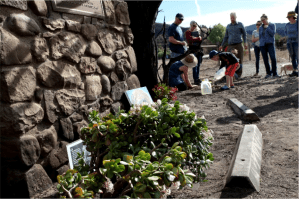
Note: This reflection was given at a Farm Church gathering at the Asistencia memorial site in California’s Ventura River Watershed on Sunday, Jan 14, 2018 (right; young Wesley Lehman waters a newly planted sycamore seedling; all photos of the gathering by Chris Wight). You can also find it on Ched’s blog.

This weekend we as a nation rightly commemorate the life and work of Dr. Martin Luther King, Jr. So a good place to start our circle this Sunday morning before the national holiday is with this passage from King’s 1963 book Why We Can’t Wait:

Our nation was born in genocide when it embraced the doctrine that the original American, the Indian, was an inferior race. Even before there were large numbers of Negroes on our shores, the scar of racial hatred had already disfigured colonial society. From the sixteenth century forward, blood flowed in battles of racial supremacy. We are perhaps the only nation which tried as a matter of national policy to wipe out its Indigenous population. Moreover, we elevated that tragic experience into a noble crusade. Indeed, even today we have not permitted ourselves to reject or feel remorse for this shameful episode. Our literature, our films, our drama, our folklore all exalt it.

Mattie
PC: Bill Wingell/National Museum of African American History and Culture/Smithsonian.

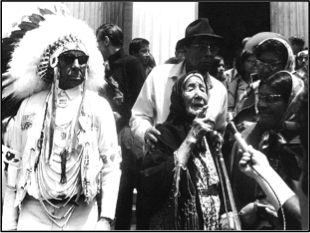
Dr. King summarizes why we are gathered as Farm Church at this unusual venue and time, for a special commemoration of a history that lingers in this very spot. [Right: Mattie Grinnell, a 101-year-old Mandan tribeswoman, speaks to the press outside the Supreme Court during the 1968 Poor People’s Campaign in Washington, D.C.]

Mohecan activist Jim Bear Jacobs taught us that westerners tend to steward our narratives through texts, while indigenous cultures understand their sacred history to be embedded in the land. The land holds the stories. And this Asistencia Santa Gertrudis memorial site is just one small, indeed hidden, chapter in the long and sordid history of Settler displacement of indigenous peoples that marks every single square mile of Turtle Island. Continue reading “Re-membering the Asistencia Santa Gertrudis”