Indigenous Resurgence

An excerpt from Noura Erakat’s recent piece (“Designing the Future in Palestine”) in Boston Review. Read the full article. It’s so worth it.

…[Palestinians] are moving in tandem with other Indigenous communities increasingly engaged in Indigenous resurgence. This is a phenomenon, explains Cherokee political scientist Jeff Corntasssel, that reframes decolonization by turning away from the state to “focus more fully on the complex interrelationships between Indigenous nationhood, place-based relationships, and community centered practices that reinvigorate everyday acts of renewal and regeneration.” This shift does not reject state-centric diplomacy or abandon the struggle against the settler sovereign. A full pivot away from such engagement would be short-sighted and counterproductive, especially for Palestinians who remain forcibly exiled from their lands and barricaded within militarized ghettoes. Rather, Indigenous resurgence centers Indigenous life and governance alongside other approaches. It seeks to undo the alienating force of colonization by reconnecting “homelands, cultures, and communities.” In particular regard to Palestinians, scholars Nour Joudah, Tareq Radi, Dina Omar, and Randa Wahbe explain, resurgence facilitates a “self-recognition” that transforms “fragmentation into a strength” and “variegated experiences of loss” into “a politics of care.”

If decolonization typically pits native against settler in a struggle for the land, Indigenous resurgence focuses on how to belong most ethically in relationship to one another and to the land. 

The Reality

By Chava Redonnet, the pastor of Oscar Romero Inclusive Catholic Church which meets in the dining room of the Rochester Catholic Worker. This is the bulletin for Sunday, January 8, 2022.                                            

Dear Friends,

On New Year’s morning, I woke up knowing what the day would hold: Second Christmas, celebrating with the family members who couldn’t make it on Christmas because of the weather. I was surprised to realize that although I was very much looking forward to time with my family, the thought of another Christmas dinner left me feeling…  unenthusiastic.  As the day went on, texting with my daughters, I realized I was not alone in that. Feeling some mounting stress, I finally texted a list of everything our family has been through in the past two months. Four of us had covid. Three job changes. Two moves, two blizzards, two missed holidays, two surgeries and a car accident. Everyone in the family has had one or more major events happen. We are exhausted! So I pointed that out, and our need for a low-key day. “We’re not going to make up for all that today,“ I said. We changed our dinner plans and ordered pizza.

In the end we had a lovely day, and enjoyed being together. We told stories, we laughed. The pizza was delicious, and no one seemed to miss the fancier meal we had planned. We downsized our expectations and that turned out to be the best thing we could have done.

Continue reading “The Reality”

Getting Rid of Jesus

By Greg Jarrell, re-posted from his blog Trespasses of the Holy (December 15, 2022)

Charlotte’s westward expansion, beyond Uptown, Biddleville, Wesley Heights, was in full swing around 1924, when Julia Alexander and her family decided to subdivide and sell off her deceased father’s estate, called Enderly. The old farm would become site of hundreds of houses, plus neighborhood businesses. And as it is with Baptist people, anywhere there was a new neighborhood, there was a new Baptist church. By December 1925, the Glenwood Baptist meeting had official status with the Mecklenburg-Association Baptist Association. The 41 charter members met in various spots along Tuckaseegee Road, but as the church grew over the rest of the Roaring ‘20s, it became clear they needed a building of their own. In 1930, in the full throes of the Great Depression, the trajectory of the church – by then called Enderly Park Baptist – was clearly on the way up, and so preparations for a new structure were made. In April of that year, the membership met as part of a revival series and voted to begin constructing a new building. Julia Alexander donated land at the corner of Tuckaseegee and Enderly Rd to site the structure on. At the revival meeting the night of the decision, Rev. J.M. Page preached on the Gerasene Demoniac, from Mark 5. His message was titled “Getting Rid of Jesus.”

To keep reading, click here.

Five Books: Charles Cha

In a new Radical Discipleship exclusive series, we are asking radical Christian leaders one question.

What are the five books or authors that have seriously shaped your spiritual life?

This is how L.A.-based activist Charles Cha answered.

The Post-Colonial Studies Reader

Beyond Civilization By Daniel Quinn

Notes on Resistance: Interviews with Noam Chomsky By David Barsamian

Anarchism: Arguments For and Against By Albert Meltzer

The Wisdom of the Enneagram By Don Richard Riso

The Quelling Word: Emancipation is Still Coming

By Ken Sehested

Written against the backdrop of New Year’s Eve services, 1862, when African Americans gathered to await news of US President Abraham Lincoln’s promised Emancipation Proclamation. Inspired by Revelation 21:1-6a, lectionary text for the New Year’s Eve Watch Night service.

The angel breaks with Heaven’s hail!

from Joy’s horizon on every weary heart,

amid that unruly, precarious land beyond

where cheery sentiment stalls and merry,

bright roads end. Now, in terrain beyond all

mapping, the adventure begins. No warranty

reaches this far. Creature comforts here are

Continue reading “The Quelling Word: Emancipation is Still Coming”

Every Day a Call to Struggle

An excerpt from Dr. Maulana Karenga’s annual Kwanzaa Message, published in the L.A. Sentinel (December 22, 2022).

Again, this year in this our season of celebration, we find humanity and the world are in severe and continuing crisis, including: the resurgent pandemic of COVID-19, constantly producing deadly variants; failed and predatory economies and expanding hunger, famine, homelessness and suffering; continuing conflicts and wars; massive displacement of peoples; unjust and irrational immigration policies; and continuing environmental degradation through plunder, pollution and depletion.

And all these oppressive practices and impositions are carried out by the rich and powerful, the obscenely armed and aggressive, who are irresponsibly and immorally unmindful and uncaring about the cost and consequences they savagely impose on humanity and the world and all in it, especially the most vulnerable among us.

Continue reading “Every Day a Call to Struggle”

Five Books: Johari Jabir

In this Radical Discipleship exclusive series, we are asking radical Christian leaders one question.

What are the five books or authors that have seriously shaped your spiritual life?

This is how Johari Jabir answered.

Just Above My Head, James Baldwin

Beloved, Toni Morrison

Hammer and Hoe: Alabama Communist During the Great Depression, Robin D.G. Kelley 

The Communism of Love: An Inquiry into the Poverty Exchange Value, Richard G. Opalsky 

The Sabbath, Abraham Joshua Heschel 

Johari Jabir is an artist, scholar, and contemplative. A native of St. Louis, Missouri, Johari is director of music at St. George & St. Matthias Episcopal Church in Chicago, IL, and he teaches in the department of Black Studies at the University of Illinois Chicago. His first book, Conjuring Freedom: Music and Masculinity in the Gospel Army of the Civil War (Ohio State University Press, 2017), is a cultural history of the nation’s first Black regiment, the 1st South Carolina Volunteers.

Five Books: Sarah Nahar

In a Radical Discipleship exclusive series, we are asking radical Christian leaders one question. What are the five books or authors that have seriously shaped your spiritual life? We asked Sarah Nahar, a recent recipient of the 2022 AMBS Alumni Ministry and Service Award. This is how she answered.

I actually read a lot of articles, short quotes, anthologies, and social media posts. That is where I get my spiritual digests from people I trust. But if I picked some books they would be:

1. Borderlands/La Frontera: The New Mestiza  by Gloria Anzaldua

2. Justice and only Justice: A Palestinian Theology of Liberation by Naim Ateek

3. The Movement Makes Us Human: An Interview with Vincent Harding by Joanna Shenk

4. Active Hope: How to Face the Mess We’re in Without Going Crazy by Joanna Macy and Chris Johnstone

5. anything and everything by bell hooks, start with Feminism is for Everybody. Yes! This was a book that had a profound spiritual impact on me when I read it before entering college as part of the mandatory reading list.

Sarah Nahar, M.Div (from Elkhart, Indiana Potawatomi traditional land) is a PhD student at Syracuse University. Her research focus is on the toilet, both the ritual and receptacle. Other interests include working on dismantling the Doctrine of Discovery, community organizing, and capoeira.

Peace on Earth and the Politics of Christmas


A VIRTUAL PROGRAM

Saturday morning, December 3

10:30 am EST

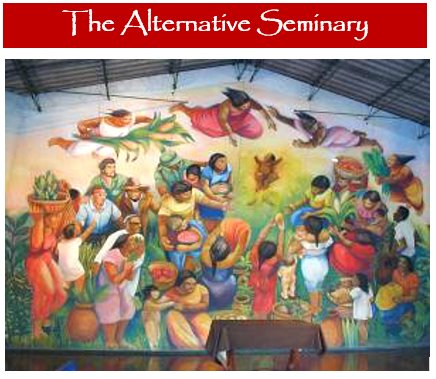
Much of the Christian church in the United States has been co-opted by an American gospel of prosperity, racism, violence, and militant nationalism. The celebration of Christmas is a victim of that co-optation: It is wrapped in innocent, Hallmark-card imagery. But in fact the biblical texts describing the coming of Jesus are making powerful assertions about the politics of the Bible that speak very much to our contemporary global crises.

In this virtual class, we will reflect on the “nativity narratives” in the Gospels of Matthew and Luke to see how they express core biblical themes of justice and liberation. We will “un-domesticate” these tales of liberation and reflect on how they are truly challenging us to a revolutionary discipleship. This program will be broadcast via Zoom. It will be facilitated by Will O’Brien, coordinator of The Alternative Seminary. A perfect event for Advent.

Continue reading “Peace on Earth and the Politics of Christmas”