Healing Trauma, Decolonizing Memory

ElaineBy Elaine Enns (right), re-posted from Vision: A Journal for Church and Theology.

All four of my grandparents fled Ukraine and Russia in the 1920s, coming to Saskatchewan with some 22,000 other Mennonite immigrants.2 During the Russian Revolution and Civil War (1917–21), they and other German-speakers endured a continuous climate of violence, plundering, rape, and killing. As a child, I knew something unspeakable had happened to them. But my grandparents spoke only about the good times and the vast abundance and beauty of the land. In my senior year at a Mennonite high school in Saskatchewan, our drama teacher had us perform a reader’s theater rendition of Barbara Claassen Smucker’s novel Days of Terror. 3 Survivors of the Zerrissenheit (a German term loosely translated as “a time of being torn apart”) spoke with us about their experience. Seeds of a call to become a “remembearer” in my community were planted in me, which have grown for thirty years. Click here to keep reading.

What is Whiteness? A Provisional Articulation

Council on the WayBy Jim Perkinson

Note: this is a long working definition of Whiteness. Dr. Perkinson laid this down for a committee reflecting in the wake of The Council on the Way (right), an October 2019 gathering of white men envisioning and embodying a redemptive white male theology. The conversation over two days in Washington D.C. was conceived and coached by Ruby Sales, theologian and veteran of the Black Freedom Struggle.

What is whiteness? I would understand the paler shades of skin color that are typically referenced, when the term “whiteness” is used, as a kind of shorthand for a whole social system of infrastructure and expectation, as well as conscious/unconscious identification. It is a system that is rooted in European Christian colonialism taking land on this continent by force (either violent conquest or coercive legal imposition) from indigenous peoples and making much of that land yield “resources” by means of enslaved African peoples (as well as other coerced peoples of color, and to some degree even coerced lower and working class European heritage peoples). Continue reading “What is Whiteness? A Provisional Articulation”

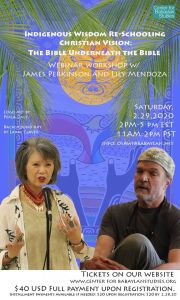
Registrations for BKI2020 Close at Midnight (PST) on 29 Jan, 2020

BillabongBartimaeus Kinsler Institute 2020: Unsettling Histories | Decolonizing Discipleship | hukišunuškuy

Click HERE to register and for more info!

This year the BKI will follow up on the Bartimaeus Kinsler Institute 2019, when we listened to and learned from a range of Indigenous voices concerning land, law and language (note: you do not need to have participated to join us in 2020).  The 2020 BKI, as Rev. Art Cribbs puts it, “aims to help us toward 20/20 vision,” by:

Unsettling Histories: Cohorts will focus on the personal and political work required of settlers and immigrants, in order that we might more deeply:

  • understand how our narratives, communities and landscapes in North America are haunted by violence and injustice, past and present; and
  • heal the myriad layers of our colonization, and colonizing behaviors, inward and outward.

Continue reading “Registrations for BKI2020 Close at Midnight (PST) on 29 Jan, 2020”

Much More Complex

GafneyFrom Dr. Wil Gafney, the author of Womanist Midrash (2017), in her podcast interview with Peter Enns and Jared Byas:

If you take seriously that women have heard throughout the centuries that what is masculine in some context is more closely identified with God, that what is feminine is other, and we even go back into church fathers like Tertullian for whom women were the devil’s gateway. I mean, there’s a whole lot of theological work that’s heavily invested in God being male and exclusively male. In fact, there’s a text that says men are the image of God and women are the image of man or something. That sets up a whole world of church and theology that marginalizes women. Yet for people who come out of the community that I did–the black church–for whom it really matters, what does the Bible say? It matters that the biblical text says repeatedly that God’s gender identity is complex. Binary language is used because the Hebrew Bible has two options. Masculine and feminine. But God is presented in a much more complex way. And that matters when we’re talking about people and hierarchy, particularly when those earthly hierarchies are entrenched in gender which is then claimed to be based on God and the Bible.

Hospitality as the Ground for Good

Hospitality-as-the-Ground-for-the-Good_800_800_90
Dough rising – it’s a braided bread night Credit: Mark Bonica (link below)

By Jayme R. Reaves. From Geez 56: Entertaining Angels.

When someone says “hospitality,” what comes to mind?

Offering a cup of coffee or tea, a hot meal, a bed for the night – these are the usual answers. When we dig deeper, there’s usually an emphasis on welcome, creating a space where people feel at home, a warmth, a commitment to the other’s wellbeing.

In English, the Latin roots for the word hospitality connote two different ideas. First, the root hostis implies both guest and host, indicating a fluidity of motion between the two, a reciprocity or exchange that is expected: “I do this for you because you did this for me.” In the ancient worlds that shaped our religious traditions, the common practice was to treat guests with respect for two main reasons. Either it was an act of diplomacy as you may be a traveler in their land one day, or because there was an understanding that a guest could have been a powerful being – a god – in disguise, testing the righteous. Therefore, welcoming a guest became a sacred ritual because you just never really know who this guest sitting at your table really is or what they may be able to do for you later. Continue reading “Hospitality as the Ground for Good”

Submit Stories and Reflections!

DODNew Year’s Greetings!

The Arts and Education Committee of the Dismantling the Doctrine of Discovery Coalition is assembling a new resource on the topic of reparations and repair. It will contain biblical and theological reflections as well as stories about how people have practiced reparative justice on the ground. Our intended audience is Anabaptist congregations, but our past resources (see here) have been used far and wide and are not limited to church folks! Continue reading “Submit Stories and Reflections!”

An Alternative Tour

51429161_10218004177755475_3993712457292972032_nBy Tommy Airey

“The time has come, God knows, for us to examine ourselves, but we can only do this if we are willing to free ourselves of the myth of America and try to find out what is really happening here.”—James Baldwin, Nobody Knows My Name (1961)

“…and a little child shall lead them.”—Isaiah 11:6b

Warning: this essay contains graphic language that may be unsuitable for some adults.

On this date, exactly a year ago, Lindsay and I found ourselves on ancient Chumash land, now called “the central coast of California.” We took the shuttle up to Hearst Castle, the 40,000 acre “ranch” built for newspaper mogul William Randolph Hearst and his wife, five sons and mistress. Early in the tour, our six-year-old nephew creatively resisted his boredom by making a game of how many nude statues he could find along the way. He was particularly fond of the penises, which made him giggle uncontrollably. Continue reading “An Alternative Tour”

Wild Lectionary: Let them Praise!

72869828_10156645667586146_9128614668779126784_oChristmas 1A

Psalm 148

By Laurel Dykstra

Salal + Cedar is the Watershed Discipleship community that curates Wild Lectionary. Psalm 148, which both celebrates and demands more-than-human praise for the creator, has become something of a “theme psalm” that we return to in worship. As it appears each year in the lectionary cycle we use it as a chance to look back at our year.

Praise God!
Praise God from the heavens
Praise in the Heights
Praise God, all you angels
Praise God, all you hosts Continue reading “Wild Lectionary: Let them Praise!”