Go out in joy

frances
By John August Swanson

A litany for worship adapted from St. Francis’ “Canticle of the Sun” and related Scripture texts

By Ken Sehested

What is it you wish to know, oh mortal one?

Do you think you must ascend to the highest heaven or descend to the deepest pit?

Do you not know that Wisdom has pitched a tent in your midst?

Ask the four-legged, and they will mentor you, or the winged-of-air, and they will school you;

Or speak to the earth, and it will teach you, or let the fish of the sea inform you.

Who does not know that the Gracious Host has done this?

In the Blessed One’s reach is the heart of every creature, the breath of every living thing.

Brother Sun declares the Beloved’s glory. His voice goes out o’er all the earth, his words to every inhabited place.

Sister Moon and stars pour forth speech to brighten the night in splendor and counsel.

Now hear the blessed promise of old, made new in your hearing:

May you go out in joy and be led back in peace, the hills bursting in song, the trees in applause!˙

©ken sehested @ prayerandpolitiks.org, adapted from Job 12:7-10, Psalm 19:1-4, Psalm 97:6, Isaiah 55:12 and St. Francis of Assisi’s “Canticle of the Sun”

Practice, Not “The Right Name”

Binding30 years in and Ched Myers’ Binding the Strong Man: A Political Reading of Mark’s Story of Jesus(1988) is more relevant than ever. This week’s commentary homes in on Mark 9:38-50.

The arrogance in John’s objection lies in its attempt to erect boundaries around the exercise of compassionate ministry “in Jesus’ name.” He equates exorcism with the accrual of status and power, and wishes to maintain a monopoly over it. This is especially ludicrous in light of the disciples’ lack of exorcism power, which we have just witnessed (9:14-29). But more importantly, it cuts directly against the grain of “receiving” in 9:37, an exhortation to inclusion, not exclusivity. On top of all this, John’s censure is based on the fact that the stranger “was not following us.” The disciples want to be followed, not followers. Never was a “royal we” less appropriate! Continue reading “Practice, Not “The Right Name””

But Herein Lies The Trap

Michelle AlexanderFrom Michelle Alexander’s The New Jim Crow: Mass Incarceration in the Age of Colorblindness (2010):

The genius of the current caste system, and what most distinguishes it from its predecessors, is that it appears voluntary. People choose to commit crimes, and that’s why they are locked up or locked out, we are told. This feature makes the politics of responsibility particularly tempting, as it appears the system can be avoided with good behavior. But herein lies the trap. All people make mistakes. All of us are sinners. All of us are criminals. All of us violate the law at some point in our lives. In fact, if the worst thing you have ever done is speed ten miles over the speed limit on the freeway, you have put yourself and others at more risk of harm than someone smoking marijuana in the privacy of his or her living room. Yet there are people in the United States serving life sentences for first-time drug offenses, something virtually unheard of anywhere else in the world.

A Revelation

Descending, Front CoverAn excerpt from Tommy Airey’s recent release Descending Like A Dove: Adventures in Decolonizing Evangelical Christianity.

A few weeks into 2016, the Flint water crisis went viral. Tap water was poisoned with high levels of lead and bacteria. As complaints from residents came pouring in, city and state officials did nothing to change the situation. Just denial. For almost two whole years.

A month after the crisis made the headlines of every major newspaper in the world, Flint native and retired autoworker Claire McClinton drove sixty miles south to visit a group of us organizing for clean and affordable water in Detroit. These were Claire’s opening remarks:

We send you greetings from the occupied city of Flint. You can go to the gas station and get lead-free gas. You can go to the hardware store and get lead-free paint. Even a capitalist knows the dangers of lead. But we can’t go to our sink and get lead-free water. I’ve got PTSD. In fact, everybody’s got it if you care about humanity.

Continue reading “A Revelation”

Wild Lectionary: Singing to Remain

42231074_2050280608615737_1575086531759046656_o.jpg
Art by Aliesha Shutte

Renewing Corporate Memory for our Ecological Dark Night

Proper 21(26) B
19th Sunday after Pentecost

By Jason Wood

Psalm 124

One of the things I’ve struggled the most with in singing contemporary worship songs is the almost exclusive focus on “me.” If you grew up like I did in a variety of evangelical churches, we tended to sing a lot of songs about how “I could sing of your love forever,” or how God “set me free,” or “here I am to worship.” And I really don’t mean to bash that, because there’s a lot that’s beautiful about reminding ourselves of the deeply personal and intimate love of God. The Christian faith proclaims: God does love me, and because of that I can live a transformed life. Continue reading “Wild Lectionary: Singing to Remain”

Understanding & Responding to the Doctrine of Discovery

DoDBy Will O’Brien, executive director of Project H.O.M.E. in Philly and the curator of the Alternative Seminary

*This Saturday, September 29, the Alternative Seminary and a group of Mennonite pastors are hosting a gathering in Philadelphia to deepen understanding and discern a call to respond to the Doctrine of Discovery

Of the many crimes perpetrated through history in the name of an imperialized Christ, one of the most pernicious is also one of least known.

The “Doctrine of Discovery” is a philosophical and legal framework dating to the 15th century that gave “Christian” governments in Europe the moral and legal rights to invade and seize indigenous lands and dominate indigenous peoples. For more than five centuries, this doctrine and the laws based upon it have legalized the theft of land, labor, and resources from across the world – crimes that continue to this day. Continue reading “Understanding & Responding to the Doctrine of Discovery”

Learning from Laughter and the Trees: He Comes with the Mountains

20180618_150922
Cedar at the Poor People’s Campaign action on June 18 in Detroit.

By Lydia Wylie-Kellermann

“You have rocks in your bag.”

Stunned, I said, “it’s possible. I have kids.” I searched frantically through my bag that I had carefully packed that morning in hopes of getting quickly through security at the 36th District Court before court. I tried to gloss over the contraband tics tacs and pencil I had hidden at the bottom- necessities for keeping a 2-year-old silent in the court room that day. I can’t find anything. They wait, “Check another pocket.” Sure enough, there in the front, I find them. I pull out hands filled with mountain stones, Detroit River rocks, and pine cones all covered in sand that pours through my fingers. I hand them over to the security guard who doesn’t flinch as I apologize and she heads for the trash can. Continue reading “Learning from Laughter and the Trees: He Comes with the Mountains”

Prayer for a Blue Day

candleBy Dee Dee Risher

Oh God, I wake up to weather
in this world you created whole and intricate
and I think how it matters;
How sun, season, gray or blue
can turn my heart. Such a little
and a cosmic thing.

And I ponder that in a world of agony,
small things—heat, cold, fleas, dust,
broken appliances—
cause me more emotion than
true tragedies and losses;
earthquakes and floods
elsewhere.
Sometimes I live so small. Continue reading “Prayer for a Blue Day”

Radical Status-Reversal

Binding30 years in and Ched Myers’ Binding the Strong Man: A Political Reading of Mark’s Story of Jesus(1988) is more relevant than ever. This week’s commentary homes in on Mark 9:30-37.

They next reach the home in Capernaum. That the community would stop in here on its way south, specifically for instruction on internal matters of power and discipline, is significant, for Capernaum was the center of gravity for the first part of the Gospel (Mk 1:21; 2:1). It is here that Jesus really begins to unmask his disciples’ true aspirations to power. Not only do they not understand where Jesus is trying to lead them; they are headed full speed in the opposite direction. Mark contrives the episode for maximal irony: the disciples are caught debating who was greatest among them “on the way” (twice, 9:33b, 34a)! For Jesus’ response, Mark sets a familiar stage: the twelve are called (3:14; 4:10; 6:7; 10:32; 14:17) and Jesus takes his seat (4:1; 12:41; 13:3). The narrative signals: Pay attention to the teaching that follows! Continue reading “Radical Status-Reversal”

The Gangsterization of Our Politics

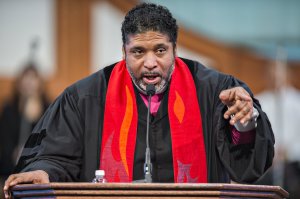
barberFrom William Barber’s recent comments in a Democracy Now interview:

Before all of the latest news, Judge Kavanaugh, first of all, was being put forward after McConnell in the Senate held open a seat for over 420 days, in a way that we had not seen since the Civil War. They literally denied a president his right to nominate someone and for them to have a hearing. This was the same Judiciary Committee that denied two African-American women a hearing to be appointed to the federal court, the 1st District—Eastern District in North Carolina. So the process was bad from the beginning. Continue reading “The Gangsterization of Our Politics”