Understanding & Responding to the Doctrine of Discovery

DoDBy Will O’Brien, executive director of Project H.O.M.E. in Philly and the curator of the Alternative Seminary

*This Saturday, September 29, the Alternative Seminary and a group of Mennonite pastors are hosting a gathering in Philadelphia to deepen understanding and discern a call to respond to the Doctrine of Discovery

Of the many crimes perpetrated through history in the name of an imperialized Christ, one of the most pernicious is also one of least known.

The “Doctrine of Discovery” is a philosophical and legal framework dating to the 15th century that gave “Christian” governments in Europe the moral and legal rights to invade and seize indigenous lands and dominate indigenous peoples. For more than five centuries, this doctrine and the laws based upon it have legalized the theft of land, labor, and resources from across the world – crimes that continue to this day. Continue reading “Understanding & Responding to the Doctrine of Discovery” →

Learning from Laughter and the Trees: He Comes with the Mountains

20180618_150922
Cedar at the Poor People’s Campaign action on June 18 in Detroit.

By Lydia Wylie-Kellermann

“You have rocks in your bag.”

Stunned, I said, “it’s possible. I have kids.” I searched frantically through my bag that I had carefully packed that morning in hopes of getting quickly through security at the 36th District Court before court. I tried to gloss over the contraband tics tacs and pencil I had hidden at the bottom- necessities for keeping a 2-year-old silent in the court room that day. I can’t find anything. They wait, “Check another pocket.” Sure enough, there in the front, I find them. I pull out hands filled with mountain stones, Detroit River rocks, and pine cones all covered in sand that pours through my fingers. I hand them over to the security guard who doesn’t flinch as I apologize and she heads for the trash can. Continue reading “Learning from Laughter and the Trees: He Comes with the Mountains” →

Prayer for a Blue Day

candleBy Dee Dee Risher

Oh God, I wake up to weather
in this world you created whole and intricate
and I think how it matters;
How sun, season, gray or blue
can turn my heart. Such a little
and a cosmic thing.

And I ponder that in a world of agony,
small things—heat, cold, fleas, dust,
broken appliances—
cause me more emotion than
true tragedies and losses;
earthquakes and floods
elsewhere.
Sometimes I live so small. Continue reading “Prayer for a Blue Day” →

Radical Status-Reversal

Binding30 years in and Ched Myers’ Binding the Strong Man: A Political Reading of Mark’s Story of Jesus(1988) is more relevant than ever. This week’s commentary homes in on Mark 9:30-37.

They next reach the home in Capernaum. That the community would stop in here on its way south, specifically for instruction on internal matters of power and discipline, is significant, for Capernaum was the center of gravity for the first part of the Gospel (Mk 1:21; 2:1). It is here that Jesus really begins to unmask his disciples’ true aspirations to power. Not only do they not understand where Jesus is trying to lead them; they are headed full speed in the opposite direction. Mark contrives the episode for maximal irony: the disciples are caught debating who was greatest among them “on the way” (twice, 9:33b, 34a)! For Jesus’ response, Mark sets a familiar stage: the twelve are called (3:14; 4:10; 6:7; 10:32; 14:17) and Jesus takes his seat (4:1; 12:41; 13:3). The narrative signals: Pay attention to the teaching that follows! Continue reading “Radical Status-Reversal” →

The Gangsterization of Our Politics

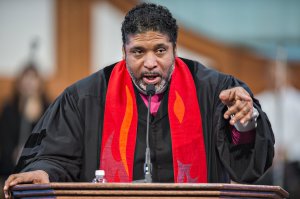
barberFrom William Barber’s recent comments in a Democracy Now interview:
Before all of the latest news, Judge Kavanaugh, first of all, was being put forward after McConnell in the Senate held open a seat for over 420 days, in a way that we had not seen since the Civil War. They literally denied a president his right to nominate someone and for them to have a hearing. This was the same Judiciary Committee that denied two African-American women a hearing to be appointed to the federal court, the 1st District—Eastern District in North Carolina. So the process was bad from the beginning. Continue reading “The Gangsterization of Our Politics” →

Why Did She Wait?

Ruby SalesAnother post from the front porch of Ruby Sales (September 17, 2018):

Republicans ask with hypocritical self righteousness that if Christine Ford’s allegation that charges Kavanaugh with sexual terrorism and attempted rape is true why did she wait thirty six years to go public?

She remained silent for the same reasons that thousands of women did not speak out. We lived in a White male patriarchy that blamed women and dismissed us as aggressive sexual predators and whores for sexual crimes against us. Sadly even women internalized this view and believed that we provoked men to commit these acts against us. Continue reading “Why Did She Wait?” →

Wild Lectionary: What is a good wife anyways?

P1020889
Photo by Caitlin Reilley Beck

18th Sunday After Pentecost
Proper 20 (25)B

Proverbs 31:10-31

By Caitlin Reilley Beck

A capable wife who can find? She is far more precious than jewels.
The heart of her husband trusts in her, and he will have no lack of gain.
She does him good, and not harm, all the days of her life.
Proverbs 31:10-11

This passage makes it clear who is writing Scripture and who isn’t. It reads like the vision board of the patriarchy, and capitalism for that matter, though it doesn’t originate in this economic system. According to this reading, the dream is to have a wife who will do a thousand different things – truly she is  one who works to “have it all.” Except, surprise, surprise, she only gets “a share in the fruit of her hands” (31:31). If this is the Bible’s job posting for being a wife in a straight, monogamous marriage, it could use some workshopping because it is not very appealing. Continue reading “Wild Lectionary: What is a good wife anyways?” →

Let’s Give It A Go

Kathleen Dean MooreOregon State Professor of Philosophy Kathleen Dean Moore was once asked, “Would you condone violence on behalf of the planet?” This was her response:

No, violence is what we are opposing. You can’t ever stop a behavior by engaging in it. Using violence only increases its power.

The reason nonviolent methods haven’t worked is because we haven’t really tried them yet. We haven’t tried massive protests and civil disobedience. We haven’t tried boycotts. We haven’t harnessed the power of the global religions. Somewhere near half of us don’t even vote. Here and there, sure, we’ve tried nonviolence, but not on the scale we need. Let’s give it a go. Continue reading “Let’s Give It A Go” →

Disobedience Here Below

35280298_10214519220947802_2199522416651141120_o
Alana Alpert, Bill Wylie-Kellermann, and others shut down the Department of Environmental Quality on June 4 as part of the Poor People’s Campaign.

Re-shared from Tikkun.

Ordained from Hebrew College of Boston in 2014, Rabbi Alana Alpert serves a dual position as rabbi of Congregation T’chiyah and as a community organizer with Detroit Jews for Justice. Because they have been working closely together on the Michigan Poor Peoples Campaign, she invited Rev. Bill Wylie-Kellermann to share the teaching for Rosh Hashanah. A graduate of Union Theological Seminary in NYC, Bill is a non-violent activist, author, and United Methodist pastor recently retired from St Peter’s Episcopal, Detroit. What follows are their remarks for the day.

Rabbi Alana Alpert: Shanah tovah!!!

I suppose you are used to most of my heresies by now, but I’ll admit a new one: vegan coneys. There is a new place in Brush Park. Just a few weeks ago, I sat around a long table of Detroit Jews for Justice leaders discussing the implications of our recent arrests as part of the Poor People’s Campaign, a national campaign uniting tens of thousands to challenge the evils of systemic racism, poverty, the war economy, ecological devastation & the nation’s distorted morality. Continue reading “Disobedience Here Below” →

On the Eve of Hurricane Florence

index
Hurricane Florence from BBC

By Kateri Boucher

It’s so easy for me to still think of climate change as some kind of amorphous, future-tense crisis. Something I’ll have to deal with, for sure, just not right now. But what’s happening to our planet is not a future crisis; it is a living, breathing, current reality. Millions of people around the world have already come face to face with their personal nightmares of “climate dystopia,” and many of them haven’t made it out alive. Monsoons in South Asia; drought in East Africa; heat waves in India and Pakistan; hurricanes on the US Atlantic coasts. And here is the thing that we must keep reminding ourselves: those who are ALREADY most marginalized, oppressed, and exploited by global systems of power are those who will continue to suffer the most.

Right now, as I type, South Carolina’s MacDougall Correctional Institution (a privately owned corporation) is holding hundreds of inmates in their cells, despite a mandatory evacuation order from the Governor. For those prisoners, this current moment is a living “dystopia” in ways that many of us can’t even begin to imagine. The Campaign to Fight Toxic Prisons has organized an informal phone zap (link in comments) to pressure SC officials to evacuate all prisons in the flood zone. I’m not sure of its status right now, but if anyone else knows of other ways to support the prisoners please share more info in the comments.

In the coming days and weeks (and months and years and decades), many many others will need support as well. And looking ahead, here are the questions I’m holding in my heart: How will we find ways to support those most affected by this storm? Can we see this storm as a symptom of a much larger sickness — and what will we do to address the root causes of illness? How would it feel to actually sit with the heaviness of this collective global moment? Who are my neighbors? Who are your neighbors? What would it actually mean to love our neighbors as ourselves? Like, actually actually? What would we have to give up if we do? What would we have to give up if we don’t?

***

It’s okay to let yourself mourn.