Blessed Assurance: Call to the Table in the Face of Terror

ChildrenBy Ken Sehested

One important thing that hasn’t been said this week [about the savagery of separating of children from parents at the US-Mexican border] is that this Department of Justice policy change is in fact a form of terrorism.

The point of terrorism isn’t killing people. Terrorists make strategic use of aggressive trauma to spread fear for the purpose of affecting social or political objectives. Look up the FBI’s definition.* Continue reading “Blessed Assurance: Call to the Table in the Face of Terror”

Hauling the Sanctuary on to the Street

Marian (1)By its simple public character a measure of light is directed upon an otherwise hidden and inconspicuous evil. By it an aspect of the historical crisis is expressly identified.  A kairos moment of decision for the community of faith is named and commended and acted upon.
Bill Wylie Kellermann, Seasons of Faith and Conscience: Kairos, Confession, Liturgy (1991)

More than a quarter century ago, Detroit native and ordained United Methodist Bill Wylie-Kellmann coined the phrase “liturgical direct action” to describe a brand of Christian witness that goes beyond charitable giving and moves outside the church building to expose and resist the powers that be.  Now 70 and retired from formal ministry, Bill is still hauling the sanctuary out on to the street.  Yesterday, in downtown Detroit, he joined 250+ friends and faithful in the final moral Monday of the national Poor People’s CampaignContinue reading “Hauling the Sanctuary on to the Street”

Like a Mustard Seed

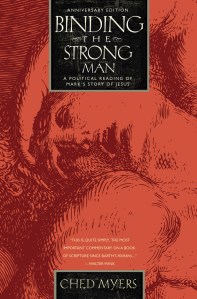
BindingToday, we continue our celebration of the 30th anniversary of Binding The Strong Man, Ched Myers’ extraordinary political reading of Mark’s Gospel.  Each Sunday, we will post excerpts from Myers’ comments on the lectionary reading of the day.  Today’s passage is Mark 4:26-34.

He also said, “With what can we compare the kingdom of God, or what parable will we use for it? It is like a mustard seed, which, when sown upon the ground, is the smallest of all the seeds on earth; yet when it is sown it grows up and becomes the greatest of all shrubs, and puts forth large branches, so that the birds of the air can make nests in its shade. (Mark 4:30-32)

In the famous parable of the mustard seed Mark one last time expands upon the theme of sowing in the earth (4:30-32).  There can be no question that this similitude concerning the disproportion between the seed and the mature plant is meant to instill courage and hope in the small and fragile discipleship community for its struggle against the entrenched powers.  As in 4:29, the appended scriptural citation places the parable firmly within a political context.  Mark adopts the conclusion of Ezekiel’s cypress tree parable for his own: the “small sprig” planted by Yahweh will bear fruit, and its branches will give shelter to birds (Ezekiel 17:22f).  In late biblical literature the sheltering branch was a common metaphor for political hegemony.  Daniel explains the image to Nebuchadnezzar: Continue reading “Like a Mustard Seed”

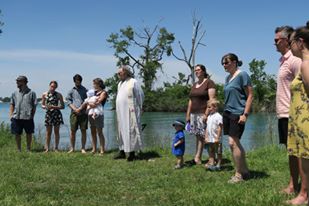
Into this River: For your baptisms Ira and Cedar from your parents

baptismWritten by Lydia Wylie-Kellermann
with  Erinn Fahey, Lucia & Daniel Wylie-Eggert

For the baptisms of Ira Cole and Cedar Martin
June 11, 2017

With the swallows in quick flight
The willows making music in the wind
The movement of the water at our feet
And a circle of people we love
We step into this river Continue reading “Into this River: For your baptisms Ira and Cedar from your parents”

Wild Lectionary: Where the Mustard Seed Grows

IMG_2066.JPGOn the Road to Golgotha

Proper 6 (11) B
4th Sunday after Pentecost

Mark 4:30-32

By Anne Ellis

The day was beautiful, the strangely liminal day that is Holy Saturday. Good Friday had come and gone and we awaited the Good News of the Empty Tomb. Knowing it would come made the day of waiting oddly anticipatory, there was an air of excitement and without realising it we instinctively moved  towards joy. We don’t like to feel the pain and suffering of Good Friday any longer than we absolutely have too, so it’s easy to slip and forget that those alive and grieving on that first Holy Saturday so long ago had no idea how the story would continue. Continue reading “Wild Lectionary: Where the Mustard Seed Grows”

What Remains

psalmBy Dee Dee Risher

For her 40th birthday, my friend, artist Michaelanne Harriman Helms asked a group of artist friends to spend a year reflecting on Psalm 90. We all did work—some of it visual art, some of it written. She asked me to write on the themes that came up for me, sparked by the psalm. For me, that became a three-part poem. But for our broad community at Radical Discipleship, I have adapted that poem into this psalm-prayer. I suggest reading Psalm 90, then this redaction of my poem.

To gain a heart of wisdom, I must
no longer
number my days:
release the clock that haunts
my small self,
lusting after illusions of influence
which will decay, scatter, leave no mark Continue reading “What Remains”

Binding The Strong Man

BindingAs we transition into the summer months of Ordinary Time, we are celebrating the 30th anniversary of Binding The Strong Man, Ched Myers’ extraordinary political reading of Mark’s Gospel.  Each Sunday, we will post excerpts from Myers’ comments on the lectionary reading of the day.  Today’s passage is Mark 3:20-35, the episode in which the book is named after.

But no one can enter a strong man’s house and plunder his property without first tying up the strong man; then indeed the house can be plundered. (Mark 3:27)

Mark has come clean: Jesus (a.k.a. “the stronger one” heralded by John, 1:8) intends to overthrow the reign of the strong man (a.k.a. the scribal establishment represented by the demon of 1:24).  In this parable the oracle of Second Isaiah lives again: Yahweh is making good on the promise to liberate the “prey of the strong (LXX, ischuontos) and rescue the captives of the tyrants” (Is 49:24f).  Imperial hermeneutics, ever on the side of law and order, will of course find this interpretation of the strong man parable strained, offensive, shocking.  Yet Mark drew the image of breaking and entering from the most enduring of the primitive Christian eschatological traditions: the Lord’s advent as a thief in the night (Mt 24:43 par; I Thes 5:2; 2 Pt 3:10; Rev 3:3, 16:15). Continue reading “Binding The Strong Man”

The Ideal Human Being

Jon SobrinoSalvadoran theologian Jon Sobrino reflecting on the Good Samaritan in his The Principle of Mercy: Taking the Crucified People From the Cross (1994):

This parable is a presentation of what it is to be a human being. The ideal, total human being is represented as one who has seen someone else lying wounded in the ditch along the road, has re-acted, and has helped the victim in every way possible…The ideal human being, the complete human being, is the one who interiorizes, absorbs in her innards, the suffering of another—in the case of the parable, unjustly afflicted suffering—in such a way that this interiorized suffering becomes a part of her, is transformed into a internal principle, the first and the last, of her activity. Mercy, as re-action, becomes the fundamental action of the total human being.

Wild Lectionary: Imperial Logic and Creation

cows enslavedProper 5(10)B

1 Samuel 8:4-20, 11:14-15
Genesis 3:8-15

By Wes Howard-Brook and Sue Ferguson Johnson

Then Joseph said to the people, “Now that I have this day bought you and your land for Pharaoh, here is seed for you; sow the land. And at the harvests you shall give one-fifth to Pharaoh, and four-fifths shall be your own, as seed for the field and as food for yourselves and your households, and as food for your little ones.”  They said, “You have saved our lives; may it please my lord, we will be slaves to Pharaoh.” (Gen 47.23-25) Continue reading “Wild Lectionary: Imperial Logic and Creation”

The Seminary, The Sanctuary & The Streets

Valerie Jean
PC: Valerie Jean

By Bill Wylie-Kellermann

There are a number of sweet connections between Word and World and the Poor Peoples Campaign: A National Call for Moral Revival. As the campaign heats up in the midst of these 40 days of action and witness, it’s worth remembering a few of them.

In 2003, we did one off our Peoples’ Schools, a week-long institute in Philadelphia. It was framed around a close study of Dr. King’s Riverside Church speech, “Beyond Vietnam: Breaking the Silence” which focused his national call for a “revolution of values.” In addition to the Plowshares Movement, that school included attention to the Kensington Welfare Rights Union in Philly, specifically their homeless union tent city which subsequently, as winter approached, broke open and moved into a boarded up Catholic Church, St. Edwards. Continue reading “The Seminary, The Sanctuary & The Streets”