Strategies of a Subversive Movement

BindingWe continue our celebration of the 30th anniversary of Binding The Strong Man, Ched Myers’ political reading of Mark’s Gospel.  Today’s passage is Mark 6:1-13.

There is no indication that Jesus’ “orders” are unique to this mission; they are for “the way” (eis hodon)–that is, paradigmatic of discipleship lifestyle (6:8).  Their narrative significance lies not in some model of heroic asceticism (which would contradict Jesus’ ambivalence toward, e.g., fasting), but in the emphasis upon the utter dependence of the disciples upon hospitality.  The “apostles” (so designated for the only time in Mark upon their return from the mission in 6:30) are allowed the means of travel (staff, sandals) but not sustenance (bread, money bag and money, extra clothes).  In other words, they, like Jesus who has just been renounced in his own “home,” are to take on the status of a sojourner in the land.  We might note that the “donning of sandals” as a Markan metaphor for discipleship was missed by both Matthew (who forbids them, Mt 10:10) and Luke (who omits the reference, Lk 9:3). Continue reading “Strategies of a Subversive Movement”

Wild Lectionary: Wild and Unpredictable Incarnate Word

onondaga
Photo credit Holly Rockwell

Proper 9 (14) B
7th Sunday after Pentecost
Mark 6:1-3

By Holly Rockwell

 Jesus left that place and went to his hometown . . . he began to teach in the synagogue, and many who heard him were astounded.   They said, “Where did this man get all this? What is this wisdom that has been given to him? What deeds of power are being done by his hands! Is not this the carpenter, the son of Mary and brother of James and Joseph and Judas and Simon. Aren’t his sisters here with us?” And they took offense at him.

“Where did this man get all this?”

The townspeople hear and comment on Jesus’ wisdom, note his healing power, and are “astounded.” And still they are blinded by what they think they already know. Continue reading “Wild Lectionary: Wild and Unpredictable Incarnate Word”

Healing Two Daughters

BindingWe continue our celebration of the 30th anniversary of Binding The Strong Man, Ched Myers’ political reading of Mark’s Gospel.  Today’s passage is Mark 5:21-43.

“Then one of the leaders of the synagogue named Jairus came and, when he saw him, fell at his feet and begged him repeatedly, “My little daughter is at the point of death. Come and lay your hands on her, so that she may be made well, and live”…Now there was a woman who had been suffering from hemorrhages for twelve years. She had endured much under many physicians, and had spent all that she had…”–Mark 5:22-23, 25-26

On the one hand, the synagogue ruler, Jairus (one of the rare named characters in Mark’s story), makes an assertive approach to Jesus, as befits male social equals.  This man was both “head” of his family (thus appealing on behalf of his daughter) and “head” of his social group (leader of the synagogue, archisunagogoon).  The man falls down at Jesus’ feet, a proper granting of honor prior to asking a favor. Continue reading “Healing Two Daughters”

Wild Lectionary: Discerning the Body Learning to Be Aware Before We Act

Proper 8(13)B
Mark 5:21-43

By Ragan Sutterfield

I have a small garden in my front yard, a smattering of plants, haphazardly planted–perennials and annuals, flowers and herbs and vegetables, “weeds” that I’ve welcomed and cultivated for their benefits to the soil and small wild things that make my yard their home. I water infrequently and mulch heavily–a plant must do well here or I take it out for something that won’t be too much trouble to grow.

Continue reading “Wild Lectionary: Discerning the Body Learning to Be Aware Before We Act”

The Other Side

BindingWe continue our celebration of the 30th anniversary of Binding The Strong Man, Ched Myers’ political reading of Mark’s Gospel. Mark, according to Myers, represents a dissenting socio-political movement.  As the narrative continues, Jesus breaks through the social and economic barriers to the realization of human solidarity.  Today’s passage is Mark 4:35-41.

“On that day, when evening had come, he said to them, ‘Let us go across to the other side.’ And leaving the crowd behind, they took him with them in the boat…”–Mark 4:35-36

…the two sides of the Sea of Galilee symbolize Jewish and gentile territory, and the two major boat journeys represent the crossing from one side to the other.

…Throughout the Gospel, Mark is far more interested in articulating geo-social “space” in terms of narrative symbolics than actual place-names.  Indeed, it is not impossible that Mark may have intentionally dissociated the coordinate “other side” from a literal correspondence with eastern and western shores of the sea;  straining the geographical credulity of the sea narrative would have forced his first readers to focus upon the journeys as symbolic action (which is their purpose) rather than upon details of marine transit around the Sea of Galilee (which is not).  Continue reading “The Other Side”

Blessed Assurance: Call to the Table in the Face of Terror

ChildrenBy Ken Sehested

One important thing that hasn’t been said this week [about the savagery of separating of children from parents at the US-Mexican border] is that this Department of Justice policy change is in fact a form of terrorism.

The point of terrorism isn’t killing people. Terrorists make strategic use of aggressive trauma to spread fear for the purpose of affecting social or political objectives. Look up the FBI’s definition.* Continue reading “Blessed Assurance: Call to the Table in the Face of Terror”

Hauling the Sanctuary on to the Street

Marian (1)By its simple public character a measure of light is directed upon an otherwise hidden and inconspicuous evil. By it an aspect of the historical crisis is expressly identified.  A kairos moment of decision for the community of faith is named and commended and acted upon.
Bill Wylie Kellermann, Seasons of Faith and Conscience: Kairos, Confession, Liturgy (1991)

More than a quarter century ago, Detroit native and ordained United Methodist Bill Wylie-Kellmann coined the phrase “liturgical direct action” to describe a brand of Christian witness that goes beyond charitable giving and moves outside the church building to expose and resist the powers that be.  Now 70 and retired from formal ministry, Bill is still hauling the sanctuary out on to the street.  Yesterday, in downtown Detroit, he joined 250+ friends and faithful in the final moral Monday of the national Poor People’s CampaignContinue reading “Hauling the Sanctuary on to the Street”

Like a Mustard Seed

BindingToday, we continue our celebration of the 30th anniversary of Binding The Strong Man, Ched Myers’ extraordinary political reading of Mark’s Gospel.  Each Sunday, we will post excerpts from Myers’ comments on the lectionary reading of the day.  Today’s passage is Mark 4:26-34.

He also said, “With what can we compare the kingdom of God, or what parable will we use for it? It is like a mustard seed, which, when sown upon the ground, is the smallest of all the seeds on earth; yet when it is sown it grows up and becomes the greatest of all shrubs, and puts forth large branches, so that the birds of the air can make nests in its shade. (Mark 4:30-32)

In the famous parable of the mustard seed Mark one last time expands upon the theme of sowing in the earth (4:30-32).  There can be no question that this similitude concerning the disproportion between the seed and the mature plant is meant to instill courage and hope in the small and fragile discipleship community for its struggle against the entrenched powers.  As in 4:29, the appended scriptural citation places the parable firmly within a political context.  Mark adopts the conclusion of Ezekiel’s cypress tree parable for his own: the “small sprig” planted by Yahweh will bear fruit, and its branches will give shelter to birds (Ezekiel 17:22f).  In late biblical literature the sheltering branch was a common metaphor for political hegemony.  Daniel explains the image to Nebuchadnezzar: Continue reading “Like a Mustard Seed”

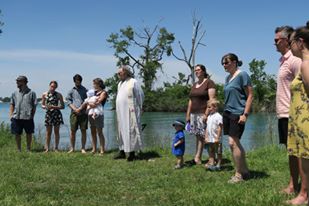
Into this River: For your baptisms Ira and Cedar from your parents

baptismWritten by Lydia Wylie-Kellermann
with  Erinn Fahey, Lucia & Daniel Wylie-Eggert

For the baptisms of Ira Cole and Cedar Martin
June 11, 2017

With the swallows in quick flight
The willows making music in the wind
The movement of the water at our feet
And a circle of people we love
We step into this river Continue reading “Into this River: For your baptisms Ira and Cedar from your parents”

Wild Lectionary: Where the Mustard Seed Grows

IMG_2066.JPGOn the Road to Golgotha

Proper 6 (11) B
4th Sunday after Pentecost

Mark 4:30-32

By Anne Ellis

The day was beautiful, the strangely liminal day that is Holy Saturday. Good Friday had come and gone and we awaited the Good News of the Empty Tomb. Knowing it would come made the day of waiting oddly anticipatory, there was an air of excitement and without realising it we instinctively moved  towards joy. We don’t like to feel the pain and suffering of Good Friday any longer than we absolutely have too, so it’s easy to slip and forget that those alive and grieving on that first Holy Saturday so long ago had no idea how the story would continue. Continue reading “Wild Lectionary: Where the Mustard Seed Grows”